


.png?width=50&name=Headshots%20(6).png)
Closed claims are the workhorse for serious HEOR work, and for good reason. Enrollment continuity...
It is well established across HEOR, RWE, and Commercial Analytics that closed claims provide a complete view into a patient’s healthcare resource utilization while enrolled in their insurance plan. Sourced directly from payers, researchers also find immense value in the monthly enrollment files closed claims offer, as this data ensures that patients in a study are active. The claims themselves are fully adjudicated as well, meaning researchers trust the codes on claim have been validated by the payer.
However, for studies focused on describing the journey and outcomes of a patient cohort, it is imperative to remember claims are validated by the payer for reimbursement to the provider. Put simply, they are scrutinized such that the healthcare payer believes the CPT/HCPCS codes correctly represent the service provided to the patient, and the ICD-10 codes accurately described a condition(s) which necessitated said service. The goal is not necessarily to ensure that the claim includes all pertinent information for an HEOR analysis. Therefore, it’s worth asking whether any valuable data is lost in the process. To explore this question, we compared how the exact same encounters are represented in open versus closed claims, with the goal of determining which source provides the most complete and useful information for research.
This blog is part of a series on hybrid claims data and real-world evidence. Read the first post here.
What Closed Claims Misses, Hybrid Recovers
To ensure our findings were broadly applicable, we analyzed patients across three care categories (Acute, Chronic, Mental) spanning nine total indications.
Acute
-
Type 1 Diabetic Ketoacidosis (T1DKA)
-
Orbital Cellulitis
-
Pancreatitis
Chronic
- Amyotrophic Lateral Sclerosis (ALS)
- Chronic Kidney Disease (CKD) Stages 4-5
- Chronic Obstructive Pulmonary Disease (COPD)
Mental
- Obsessive Compulsive Disorder (OCD)
- Borderline Personality Disorder (BPD)
- Major Depressive Disorder treated with Electroconvulsive Therapy (MDD w/ ECT)
Cohort Selection
- Chronic and mental health conditions required at least three occurrences of the applicable ICD-10 codes, with a minimum of six months between the first and last.
- Acute conditions required at least two qualifying claims, without the longitudinal requirement.
- For all conditions, patients were required to have at least one year of lookback and one year of follow up, either through open claims activity or continuous enrollment in closed claims (except for MDD, where we did not require the lookback).
- Cohorts were limited to patients whose index dates matched exactly in both the open and closed claims datasets.
|
Category |
# Patients |
Inclusion Criteria |
Exclusion Criteria |
|
Acute |
|||
|
T1DKA |
234 |
ICD-10 E10.1X |
ICD-10 E11.XX |
|
Orbital Cellulitis |
792 |
ICD-10 H05.01X |
- |
|
Pancreatitis |
17,076 |
ICD-10 K85.XX |
- |
|
Chronic |
|||
|
ALS |
257 |
ICD-10 G12.21 |
ICD-10 G10, ICD-10 G20X |
|
CKD Stages 4-5 |
14,339 |
ICD-10 N18.4, N18.5, N18.6 |
- |
|
COPD |
37,974 |
ICD-10 J44.XX |
- |
|
Mental |
|||
|
OCD |
6,693 |
ICD-10 F42.X |
ICD-10 F60.5 |
|
BPD |
4,338 |
ICD-10 F60.3 |
ICD-10 F60.2 |
|
MDD w/ ECT |
401 |
ICD-10 F33 + CPT 90870 |
- |
Following cohort selection, we examined a 365-day period after each patient’s index date and identified claims that were present in both open and closed claims. A “claim” was defined as a unique combination of patient identifier, service/statement from and to dates, and claim type (institutional or professional).
Below is the total number of overlapping claims found per indication.
|
Indication |
# of Open Claims |
# of Closed Claims |
# of Overlapping Claims |
|
Acute |
|||
|
T1DKA |
3,341 |
4,272 |
2,839 |
|
Orbital Cellulitis |
16,667 |
26,909 |
14,052 |
|
Pancreatitis |
441,932 |
676,018 |
357,855 |
|
Chronic |
|||
|
ALS |
8,640 |
12,205 |
6,529 |
|
CKD Stages 4-5 |
555,177 |
956,240 |
466,783 |
|
COPD |
1,105,897 |
1,798,713 |
947,446 |
|
Mental |
|||
|
OCD |
162,350 |
210,977 |
134,270 |
|
BPD |
142,297 |
181,948 |
117,177 |
|
MDD w/ ECT |
14,926 |
20,587 |
12,138 |
On each of these overlapping claims, we looked at the differences in variables that are most commonly used to describe cohorts and define outcomes:
- Diagnosis Codes (ICD10)
- Procedure Codes (CPT/HCPCS)
- Place of Service Codes
- Type of Bill Codes
- Provider NPI
.png?width=1920&height=600&name=Blog%20Charts%20%20(3).png)
.png?width=1920&height=600&name=Blog%20Charts%20%20(2).png)
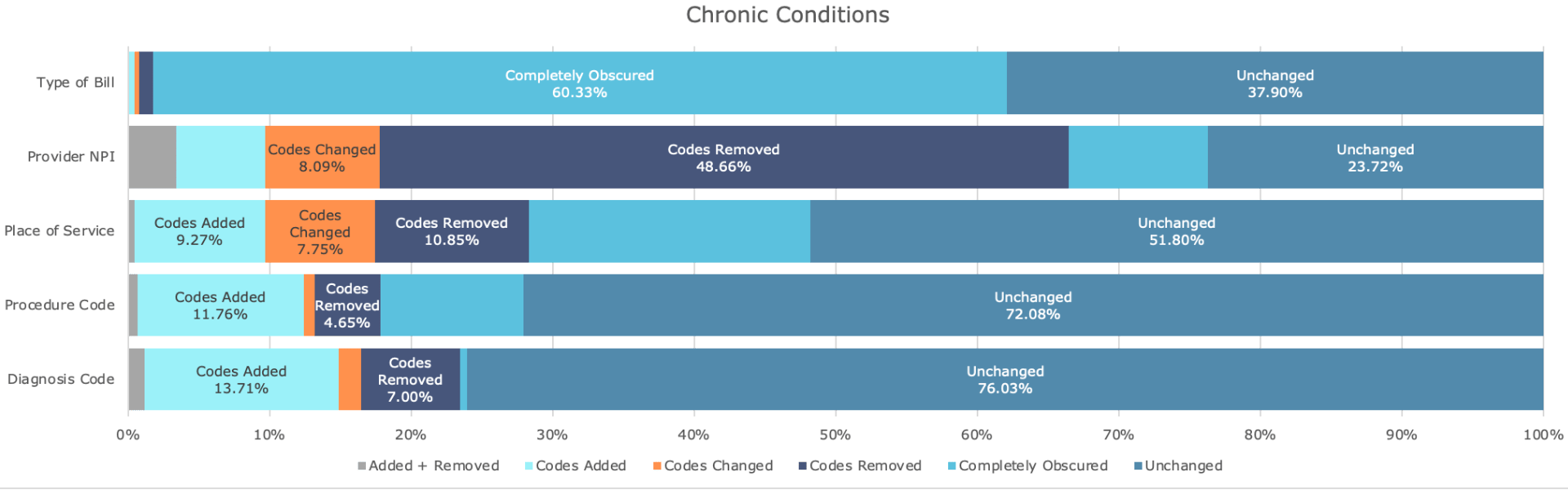
Diagnosis Codes Are Largely Consistent Across Claims Sources
(72%-85% unchanged depending on indication category)
Across all indications, changes in diagnosis codes were relatively uncommon when translating an encounter from open claims to closed claims. When differences occurred, closed claims were most often a superset of open claims, meaning the sequence of diagnoses contained all codes present on the open claim plus additional codes.
In acute and chronic conditions, this occurs around twice as often as the inverse (Codes Removed + Completely Obscured) where open claims are a superset of closed (16% vs 9% and 14% vs 7% respectively). However, the difference is less pronounced in Mental Conditions (7% vs 6%). The most common codes which were changed between the claim sources are shown below for patients in the CKD, MDD w/ ECT, and Pancreatitis cohorts sorted by number of encounters where closed claims were additive.
|
Patients with Late Stage CKD |
# of Encounters |
||
|
Code |
Description |
Added by Closed |
Removed from Open |
|
R69 |
Illness, Unspecified |
21,923 |
0 |
|
I10 |
Essential (Primary) Hypertension |
9,360 |
4,971 |
|
N179 |
Acute Kidney Failure, Unspecified |
6,588 |
2,327 |
|
Z6841 |
Body Mass Index [Bmi] 40.0-44.9, Adult |
4,797 |
0 |
|
N184 |
Chronic Kidney Disease, Stage 4 (Severe) |
4,632 |
2,969 |
|
Patients w/ MDD+ECT |
# of Encounters |
||
|
Code |
Description |
Added by Closed |
Removed from Open |
|
F332 |
Major Depressive Disorder, Recurrent Severe Without Psychotic Features |
156 |
79 |
|
R45851 |
Suicidal Ideations |
104 |
25 |
|
I10 |
Essential (Primary) Hypertension |
86 |
48 |
|
F329 |
Major Depressive Disorder, Single Episode, Unspecified |
81 |
69 |
|
F411 |
Generalized Anxiety Disorder |
76 |
124 |
|
Patients w/ Pancreatitis |
# of Encounters |
||
|
Code |
Description |
Added by Closed |
Removed from Open |
|
R69 |
Illness, Unspecified |
11,044 |
0 |
|
I10 |
Essential (Primary) Hypertension |
6,793 |
3,665 |
|
K8590 |
Acute Pancreatitis Without Necrosis Or Infection, Unspecified |
5,567 |
2,229 |
|
R109 |
Unspecified Abdominal Pain |
5,099 |
2,530 |
|
Z6841 |
Body Mass Index [BMI] 40.0-44.9, Adult |
3,699 |
0 |
In both CKD and Pancreatitis, ICD10 R69 (Illness, Unspecified) is the most commonly additive code in closed claims, followed by BMI 40.0-44.9 which appears to replace less specific codes such as morbid obesity and BMI greater than 40 (removed from ~6K open claims in the COPD cohort and ~4K in the pancreatitis cohort). However, neither code provides significant value in the context of cohorts and outcomes studies. Illness, Unspecified speaks for itself and provides limited clinical insight. While the BMI code may appear to be an improvement over the broader obesity-related codes, it still represents a range rather than a precise measurement of weight change, as would be available through an EMR source. Therefore, while closed claims can certainly be additive in terms of number of codes, it is important to consider the clinical relevance and utility of the codes being added.
Based on these results, there does not appear to be a clear indication that one source is inherently “better” than the other for diagnosis codes. In the majority of cases, the diagnosis codes represented in both sources are identical. When differences do occur, the most commonly added codes do not provide meaningful additional insight. Although less frequently observed, we also see meaningful diagnosis codes being removed from open claims. For each indication evaluated, at least one identifying diagnosis code was removed from open claims at a rate of more than 40% of the closed claims additions, with removals exceeding 50% in CKD and MDD (see highlighted rows), diminishing the true additive rate of closed claims.
A study which makes use of both data sources likely stands the best chance at seeing “everything” with respect to diagnosis codes.
Procedure Codes Show Similar Patterns with More Variation by Indication
In both acute and mental conditions, the procedure code breakdown looks similar to the diagnosis codes. Most of the time, the codes are unchanged, and there is a similar ratio of additive versus removal for both conditions. Chronic conditions look different. While still unchanged more than 70% of the time, encounters where the procedure codes on the open claim are a superset of those on the closed is actually more common than the opposite (15% vs 12%). This is driven mainly by COPD, where the most frequently removed code is a PA-Medicaid specific HCPCS code, W1793, Attendant care services; per 15 minutes.
|
Code |
Description |
# of Claims where Code was present in Open but not Closed |
|
W1793 |
Attendant care services; per 15 minutes |
108,069 |
|
W1895 |
Personal Emergency Response System (Monthly Maintenance) |
9,203 |
|
W1760 |
Home Delivered Meals-Frozen Entrée |
7,991 |
|
36415 |
Collection Of Venous Blood By Venipuncture |
2,374 |
|
G8427 |
Eligible Clinician Attests To Documenting In The Medical Record They Obtained, Updated, Or Reviewed The Patient's Current Medications |
2,348 |
Facility and Place of Service Details Frequently Unavailable in Closed Claims
On institutional claims, Type of Bill was completely removed about 60% of the time in closed claims, in each of the indications. This introduces an additional complexity in determining place of service of the claim.
|
|
|
# of Encounters where Code was Present in Open but not Closed Claims |
||
|
Code |
Description |
BPD |
COPD |
T1DKA |
|
111 |
HOSP/INP(INCL MDCR A)/ADM/DISCH CLM |
35,950 |
203,411 |
688 |
|
021 |
SNF/INP(INCL MDCR A)/ADM/DISCH CLM |
12,384 |
11,585 |
62 |
|
231 |
SNF/OP/ADM/DISCH CLM |
6,641 |
37,714 |
198 |
|
121 |
HOSP/INP(MDCR B ONLY)/ADM/DISCH CLM |
5,785 |
220,667 |
542 |
|
211 |
SNF/INP(INCL MDCR A)/ADM/DISCH CLM |
5,257 |
77,894 |
448 |
|
221 |
SNF/INP(MDCR B ONLY)/ADM/DISCH CLM |
5,008 |
70,770 |
169 |
|
811 |
SPECFAC/HOSPICE(NONHOSP BASED)/ADM/DISCH CLM |
3,425 |
32,149 |
53 |
|
117 |
HOSP/INP(INCL MDCR A)/REPLC OF PRIOR CLM |
0 |
53,22 |
21 |
|
131 |
HOSP/OP/ADM/DISCH CLM |
0 |
7,091 |
0 |
In the BPD, COPD, and T1DKA cohorts, the most frequently omitted Type of Bill codes corresponded to inpatient hospitals and skilled nursing facilities. This is a clear win for open claims. However, the practical implications may be less significant than they initially appear. Even without these codes, a researcher can often rely on applicable CPT/HCPCS, revenue, or DRG codes to identify the place of service. This may require some extra effort, but most HEOR teams already have a standard hierarchy of codes to use in place when determining place of service.
While these results imply open claims are unequivocally superior to closed claims for Type of Bill data, that does not necessarily diminish the value of closed claims. Researchers have access to other mechanisms for identifying place of service on institutional claims, which can help mitigate the impact of missing Type of Bill information.
Missing Provider NPIs Can Impact Specialty-Based Research
The final code type we analyzed was Provider NPI. Across all three indication categories, at least one Provider NPI present on the open claim was missing from the corresponding closed claim more than 50% of the time. This finding has important implications for research that relies on provider specialty information. For example, studies seeking to quantify specialist visit rates following treatment initiation, or those requiring diagnoses or procedures to be attributed to specific provider specialties, may be particularly affected.
To better understand the potential impact, we examined the specialty types associated with missing NPIs in the Orbital Cellulitis, ALS, and OCD cohorts. The five most frequently affected specialties for each indication are shown below.
|
Orbital Cellulitis |
ALS |
OCD |
|||
|
Specialty |
# Encounters where NPI Removed |
Specialty |
# Encounters where NPI Removed |
Specialty |
# Encounters where NPI Removed |
|
Internal Medicine |
861 |
Neurology |
478 |
Family Medicine |
4,444 |
|
Emergency Medicine |
658 |
Family Medicine |
369 |
Internal Medicine |
3,310 |
|
Family Medicine |
654 |
Internal Medicine |
309 |
Social Worker - Clinical |
2,617 |
|
Pediatrics |
538 |
Pulmonary Disease |
133 |
Emergency Medicine |
2,533 |
|
Family |
214 |
Nurse Practitioner |
86 |
Pediatrics |
2,472 |
Open claims beats closed on provider NPI. Without this detail, there is no way to know the specialty of treating physicians. Imagine a study designed to quantify specialist visit rates following initiation of a new treatment, or one that requires confirmation that a diagnosis was made by a specific provider specialty. Missing NPIs could present clear challenges in either scenario, such as skewed specialist visit rates, or a lower volume of patients when requiring a diagnosis or procedure from a specific specialist type.
The Path Forward: Leveraging Both Open and Closed Claims
So, which source is better at representing the exact same encounter, open claims or closed claims? As is often the case in healthcare data, the answer is: it depends.
For Type of Bill, Place of Service, and Provider NPI, open claims clearly contain more information. For diagnosis and procedure codes, however, there is little evidence that one source is consistently more informative than the other. Across all indications evaluated, both sources contained the exact same sequence of codes more than 70% of the time. When differences did occur, closed claims generally added more codes, although many appeared to have limited clinical relevance. At the same time, it is worth noting that clinically meaningful diagnosis codes were also removed from open claims at a nontrivial rate.
Ultimately, each source has distinct strengths and limitations. Open claims provide clear advantages for identifying place of service, Type of Bill, and provider specialty, but lack enrollment data and do not guarantee complete capture of all patient interactions. Closed claims offer enrollment information and a more complete adjudicated record, but frequently omit provider and facility-level details. Rather than relying exclusively on one source and potentially missing important context, researchers should utilize a hybrid claims approach that layers open claims onto closed claims to capture the most complete view of patient care.