

For investors funding breakthrough healthcare innovations, every quarter behaves a little...
I love a good analogy, and I realized: forecasting revenue is a lot like being on time for a dinner party. Let me explain…
Before a holiday dinner, two friends texted that they were both leaving the same mall at the same time and would meet us at the restaurant, presumably at the same time, though taking two different cars.
One made a grand entrance 25 minutes later than the other although they left at the same time. Why? The on-time friend used GPS and some local knowledge to navigate around typical back up on the entrance to I-95 (IFKYK the greater Boston area) near the mall. The friend who arrived after the appetizers were served followed a route she “always used to take” and ended up one martini (and several olives) behind the rest of us because of her biased and simplistic approach.

Healthcare Investing is Entering its GPS Chapter
Using GPS to dynamically and reliably get where you’re going now consistently outperforms deep local knowledge. Advantage goes to the driver with the tools.
Advantage also goes to the investor with healthcare product revenue predictions weeks earlier than the rest of the market (like having a say in what appetizers we order). A new chapter of dynamic intelligence is getting investors where they want to go, faster and more reliably. Let me introduce you to Kyber Focal Methods, also known as KFM.
Kyber leverages US healthcare claims data paired with a best in class tech stack to provide you with the “WazeTM” for healthcare investing.

From Paper Maps to Predictive Intelligence
To explain the analogy, think of claims data, in its most basic form, as much like a static gas station map. There is all kinds of great information in the map and you can use it to navigate to your destination, but what happens when there is traffic? An accident? You reach the edge of the map and need to stop for another one?
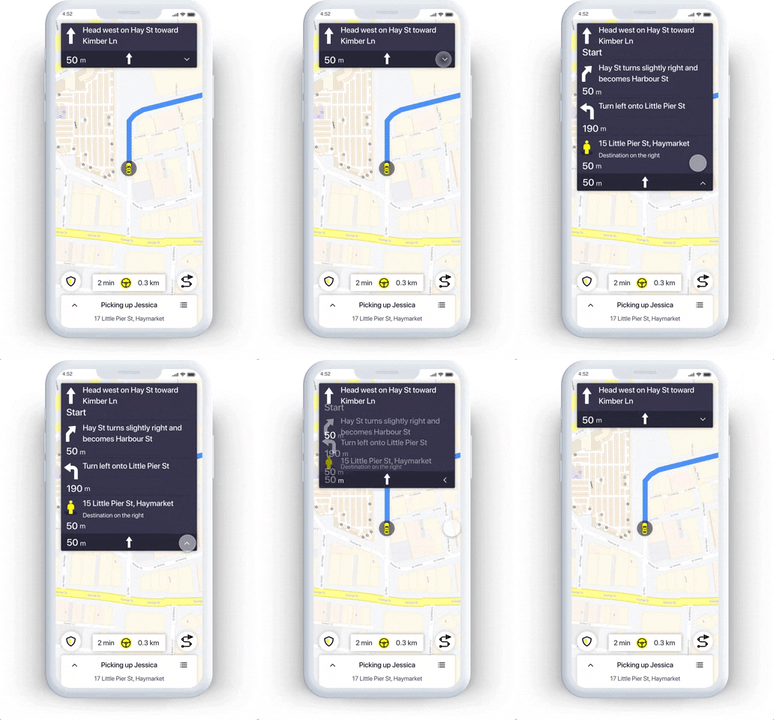
Waze and other GPS tools use machine learning to essentially take ALL the gas station maps and puts them into a single user interface that is dynamic, scalable to all destinations, actively taking in live data inputs like other drivers on the road, road closures, traffic patterns, etc. and providing an accurate prediction on when you’ll arrive at your destination.
If you want to see the play by play of how you’ll get there, you can see the direction list. If the app determines there’s a faster, better route, you’ll automatically be rerouted to the faster option.
For investors, KFM is much like Waze for healthcare claims data. Scalable across all therapeutics (with enough data), constantly improving the models with real time updates in our multivariate reality, getting you to the right prediction faster and earlier than anyone else driving on Wall Street using the gas station maps.
Healthcare Investing is Actually Much Like Wayfinding
Much like GPS, KFM helps you find the best path, without bias across a large universe of therapeutics and drugs.
- Bias: When you ask the gas station attendant for directions, you might get a biased approach using their local knowledge that sends you over one bridge, because they think it’s faster than another route because of that one time they were late to work because of an accident.
- Pattern Detection: KFM is designed to detect patterns in the complexity of the machine learning ready and feature engineered claims data set and identify those that are predictive, even when variables interact in unexpected ways. So the models can know when an accident is a one time event vs typical traffic delays during rush hour.
Kyber Focal Methods Sets the Pace for Early Forecasting
KFM is a user interface, built in Streamlit, a Snowflake add-on application, and built on the shoulders of the DataRobot and DataBricks tech stack.
- DataRobot is a machine-learning factory, built by the best data scientists in the world, taking the healthcare claims data set, testing the most modern algorithms, and deploying an ensemble of decision tree, neural network, and genetic learning models for each product level revenue prediction.
- Within the tool, we offer you the ability to:
- Discover new names and opportunities leveraging anomaly detection and the ability to curate product lists based on critical performance statistics
- Focus on specific products you already know and follow
- Dig deeper to understand the models that are being deployed, and what KPIs have the largest impact on predictions along with the historic performance of models themselves
- The model studio consistently delivers four key buckets of models with the ability to engage with the backtesting, the forecast predictions, and consensus inputs.
- The models run weekly with the most recently available claims data inputs to generate new predictions from the modern model ensemble.
The Evolving Role of Local Knowledge
Of course, there’s still a role for the local expert at the gas station, much like my friend who knew to jump ahead in the merge… knowing that Patriots home games at Gillette back up Route 1 on game days and to avoid Main Street at 3 on weekdays because of the school bus drop offs schedule, but not in July and August.
Our local experts are our healthcare research analysts. They’ve got local knowledge and at any point we can leverage them, a healthcare research expert, for a deep dive into a specific drug story that might require manual interpretation of the map to get us to a revenue estimate.
But, a major benefit to KFM is scalability and speed. To cover as many products as KFM does using the map, I’d need a clown car of 40+ back seat drivers. KFM, combined with Kyber’s local knowledge of healthcare data, products and services allows us to create and explain these predictions that consistently compete with the best equity analysts on the street.
And just like Waze, KFM will get you to your destination faster than your friends and ensure you’re not a martini behind when you arrive.
So, if you think you can take advantage of early healthcare product-level revenue predictions, then I'd like to show you Kyber Focal Methods.